
Register and Get Ready!
The second series of free virtual workshop is scheduled for October and November. Each workshop will follow the format “Show one, Try one, Explore more!”:
- Show one: a guided demo of the software by the CCDC tutors.
- Try one: a hands-on example for you to try during the session, with CCDC instructors on hand to help.
- Explore more: summary of learning outcomes, challenges, and quizzes.
All the sessions will include presentations and demonstrations by CCDC expert tutors and a hands-on part for you to try the software, with the tutors available to help you and answer your questions.
If you have any questions, feel free to email: hello@ccdc.cam.ac.uk. We’re happy to help.

Advanced Structural Visualization and Analysis of Porous Materials Using Mercury
📆Tuesday, 7th October
⌛13:30-14:00 (BST)
Special Guest Speaker: Maria Celeste Bernini, Prof. at INTEQUI-CONICET, Universidad Nacional de San Luis, Argentina.
Download
During this workshop, we will include examples of porous materials, in particular metal-organic framework (MOF) structures from the Cambridge Structural Database (CSD).
What we will cover
We will focus on tools from the CSD Software designed to enhance and assist the visualization and analysis of structural data. You will learn some tips and tricks for using a range of functionality in the desktop molecular visualization software Mercury, with spotlight on some of the new features.
You will learn:
- Which subsets of the CSD are available, how to access them in ConQuest, Mercury and the CSD Python API, and how they can help you in your research.
- How to visualize porous materials effectively in Mercury.
- How to analyse pore space in your structures using Pore Analyser.
- Applications of the disorder visualization feature, including recent advances and integrations with other functionality available in Mercury.
- And more Mercury tips and tricks!
The workshop will be recorded and all registered participants will have access to the recording.
Software requirements
You’ll need access to the CSD and have Mercury installed and activated with a valid CSD license (any).
All academic licences include access to the full range of features covered in this workshop.
If you are unsure whether your institution already has a license, please contact us using the form on the Contact Us webpage.
If you do not have access to the CSD, we can provide you with a temporary licence. When you register, please check "No" to the question: "Do you or your institution have a current full CSD licence?" and we'll get you set up.
If you have already got the CSD installed you will need to check you have the most up to date version of the software. Click here for more information.
Entry requirements
This workshop is open to everyone who wants to learn hands-on how to use Mercury to visualize and analyse structures, from beginners to experienced users.
Familiarity with the basics of Mercury would be ideal, but is not essential.
If you have not used Mercury before, we would recommend the following module from our on-demand CSDU courses: Visualisation 101 - Visualising structural chemistry data with Mercury.
Who should attend?
- Crystallographers, structural scientists and cheminformaticians.
- Academic and industrial chemists interested in exploring molecules in the solid form.
- PhD and post-doc researchers in the field of crystallography and materials science.
- Researchers and scientists who work with the CSD or their own structural databases.
- Industrial scientists using structural informatics to design new materials.
- Educators looking to incorporate the CSD into their teaching, and educators in informatics and coding areas looking for more real life examples for their classes.
How to Use Particle Informatics Tools to Connect Crystal Structure to Particle Behaviour
📆Tuesday, 21st October
⌛09:30-11:00 (BST)
Special Guest Speaker: Prof. Elena Simone from Politecnico di Torino
Download
In silico digital design methods are becoming more popular in the formulated products industries as tools to anticipate manufacturing and processing bottlenecks before they occur.
What we will cover
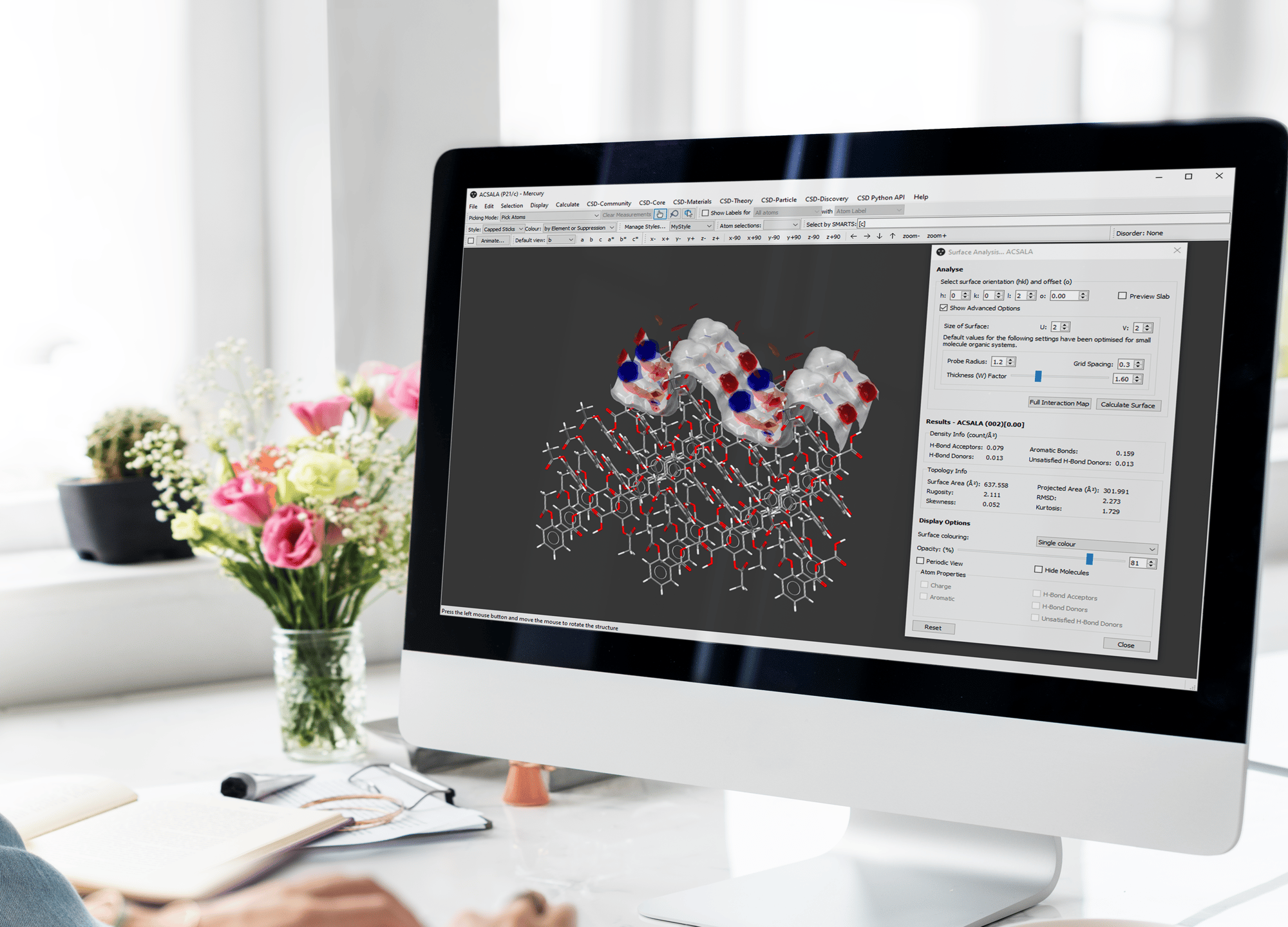
We will provide an overview of the functionality available in the CSD-Particle suite, focusing on tools for particle surface analysis. The session will include presentations and demonstrations by CCDC expert tutors and a hands-on part for you to try the software.
You will learn:
- How to use the desktop molecular visualizer software Mercury for Particle Informatics studies.
- How to use the Surface Analysis tool.
- How to calculate Full Interaction Maps on surfaces.
- Recent advances and improvements of the CSD-Particle tools.
- How you can best use Mercury and CSD-Particle in your workflows.
The tutors hosting the event have developed these tools for particle analysis alongside experts from major pharmaceutical companies and academia.
The workshop will be recorded and all registered participants will have access to the recording.
Software requirements
As this is an interactive workshop, you’ll need access to the CSD and have Mercury installed and activated with a valid CSD license (CSD-Materials + CSD-Particle for industrial or CSD-Enterprise for academics).
All academic licenses include the full range of features covered in this workshop.
If you are unsure whether your institution already has a license, please contact us using the form on the Contact Us webpage.
If you do not have access to the CSD, we can provide you with a temporary licence. When you register, please check "No" to the question: "Do you or your institution have a current full CSD licence?" and we'll get you set up.
If you have already got the CSD installed you will need to check you have the most up to date version of the software. Click here for more information.
Entry requirements
This workshop is open to everyone who wants to learn hands-on how to use the tools from the CSD-Particle suite to visualize and analyse surface properties in the context of particles.
Familiarity with Mercury and Full Interaction Maps (FIMs) would be ideal, but optional. If you have not used Mercury or FIMs before, we would recommend the following modules from our on-demand CSDU courses:
- Visualisation 101 - Visualising structural chemistry data with Mercury.
- Analysing intermolecular interactions 101 - Full Interaction Maps.
Who should attend?
- Formulation scientists.
- Crystallisation scientists.
- Research scientists concerned with particle behaviour.
- PhD and post-doc researchers interested in chemical and mechanical particle properties.
- Commercial scientists concerned with the formulation and processing of crystalline products.
- Scientists involved in manufacturing crystalline products, looking to reduce bottlenecks and predict processing issues earlier.
How to Use the Docking Software GOLD to Perform Virtual Screening Simulations
📆Tuesday, 4th November
⌛15:30-17:00 (GMT)
Special Guest Speaker: Prof. Armando Albert, Departamento de Cristalografía y Biología Estructural, Instituto de Química Física "Blas Cabrera", Consejo Superior de Investigaciones Científicas.
Download
In drug discovery, Virtual Screening (VS) is a widely used computational method to search libraries of small molecules for hit identification, lead optimization, and scaffold hopping.
What we will cover
In this virtual workshop, we will show you the basics of Hermes GUI and how to set up and run a virtual screening campaign in GOLD. Virtual Screening can reduce research time and cost by using two different approaches: Structure-Based Virtual Screening (SBVS) and Ligand-Based Virtual Screening (LBVS).
You will learn:
- Basics of structure-based virtual screening.
- Basics of the Hermes interface, the CCDC’s 3D visualizer for proteins.
- Cavity detection and extraction in Hermes.
- Step-by-step instructions on how to set up a virtual screening simulation in GOLD.
- Analysis of virtual screening results.
- Protein-ligand interactions insights using hotspots via Superstar.
The workshop will be recorded and all registered participants will have access to the recording.
Software requirements
As this is an interactive workshop, you’ll need access to the CSD and have Hermes and GOLD installed and activated with a valid CSD license (GOLD, CSD-Discovery or CSD-Enterprise).
All academic licenses include the full range of features covered in this workshop.
If you are unsure whether your institution already has a license, please contact us using the form on the Contact Us webpage.
If you do not have access to the CSD, we can provide you with a temporary licence. When you register, please check "No" to the question: "Do you or your institution have a current full CSD licence?" and we'll get you set up.
If you have already got the CSD installed you will need to check you have the most up to date version of the software. Click here for more information.
Entry requirements
This workshop is open to everyone who wants to learn hands-on how to perform virtual screening using GOLD.
A basic knowledge of docking and GOLD would be ideal, but is not essential. If you have not used GOLD before, we would recommend the following module from our on-demand CSDU courses: Protein-ligand docking 101 - running a simulation in GOLD, covering the basics of protein-ligand docking with GOLD.
Who should attend?
- Discovery scientists, computational chemists, cheminformaticians and medicinal chemists.
- Research scientists investigating protein-ligand docking.
- PhD and post-doc level scientists in academia interested in protein-ligand docking.
- Industrial / commercial scientists working on protein-ligand docking
- Scientists using computational methods in drug discovery.